Insect Protein Ingredients are Bugging More than Our Pets
IN THE HIGH-STAKES WORLD of consumer packaged goods, the “Supply Chain Paradox” is nowhere more visible than in the pet food aisle. As of early 2026, the industry was grappling with a 44% spike in the cost of organic beef and poultry—a volatility that threatens the margins of even the largest market players.
Yet, while traditional animal proteins face climate-driven shortages, an upcycled protein play is quietly gaining traction, moving from the experimental fringe to the operational core. Insect protein—black soldier flies, mealworms, crickets and more—may be the strategic hedge of 2026.
At rough count, some 40-plus global pet food brands now feature insect-based protein in their formulations, contributing to a $1.5 billion global market that includes animal feed.
Market tests validate the category
The transition of insect protein from niche to mainstream is defined by actions, not just words. While Nestlé Purina expanded its Beyond Nature’s Protein line following successful pilots in Europe, the U.S. market in 2026 is increasingly dominated by agile, specialized brands better equipped to handle high-touch consumer education. Mars Petcare’s Lovebug brand, for example, has proven that sustainability could be a primary driver for cat owners—a notoriously difficult demographic to convert.
A recent Future Market Insights outlook report, which took an in-depth look at the category, noted that the brands that win in 2026 are those that stop selling insect protein as a moral idea and start selling it as a practical feeding solution.
With the global insect-based pet food market projected to reach $168.3 million in 2026, the industry is no longer asking if consumers will buy it, but how fast it can be scaled.
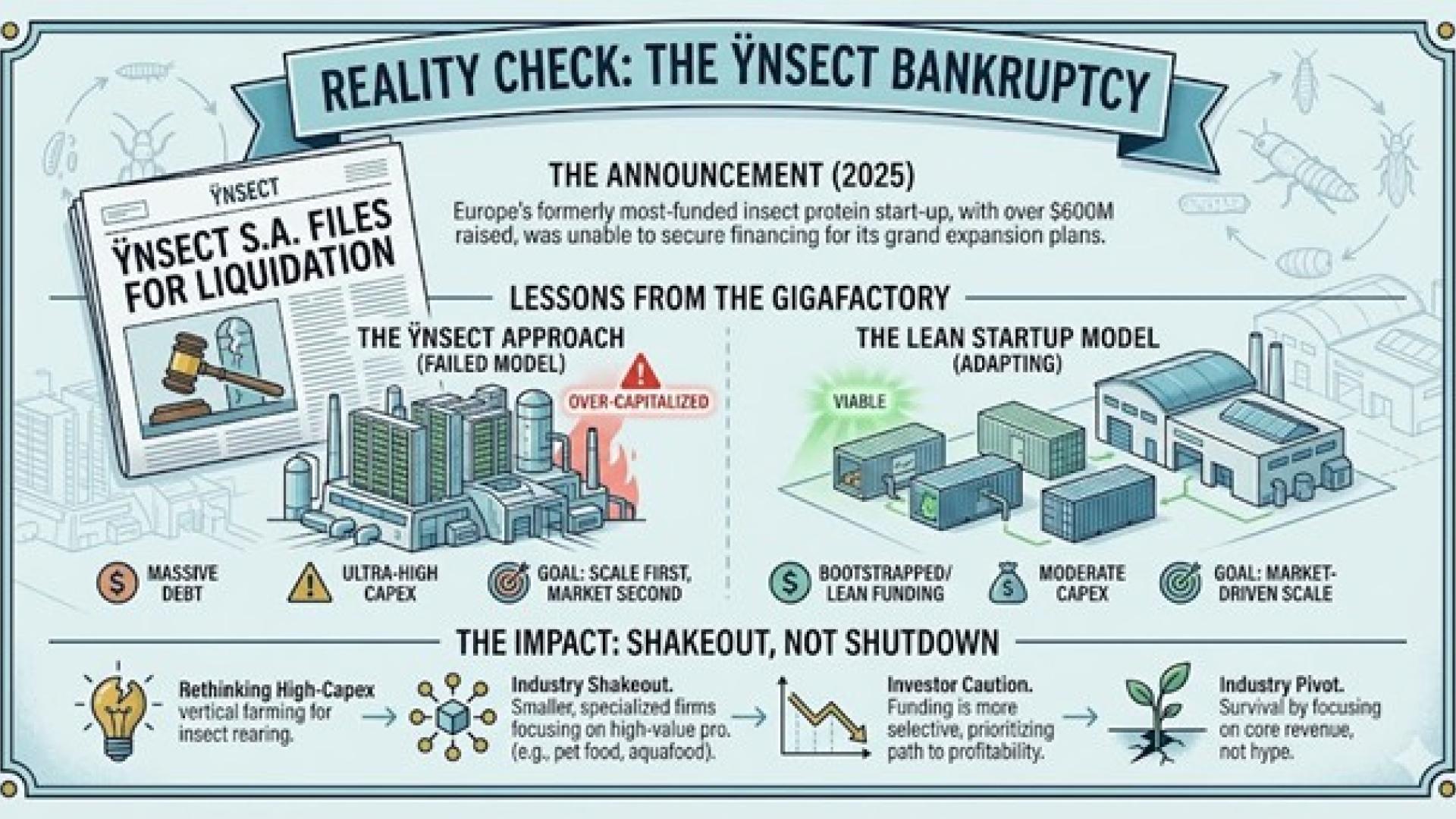
However, the path to scale thus far has not been without friction. The high-profile liquidation last December of French industry pioneer Ÿnsect serves as a cautionary tale—and a strategic pivot point—for the rest of the market (see "Reality Check" infographic above).
Premium position: superfood or low-cost play?
Aside from scale, a central question facing CPGs looking to capture the opportunity is whether insect-based proteins are being viewed as a superfood or a low-cost play. Currently, the category is firmly entrenched in the premium tier with success tied to brands who lean into specific high-margin claims. While sustainability features drove initial interest, hypoallergenic benefits now account for 22.4% of all product claims, as insects become the novel protein of choice for sensitive pets.
Companies such as Jiminy’s are finding success marketing their cricket-based dog food and treats to owners looking for a healthier and easier to digest option for their dogs. According to its leadership team, cricket protein contains prebiotics which can improve a dog’s gut health. “It’s sustainable, nutritious, humane and hypoallergenic which checks a lot of boxes for many of today’s pet owners,” said Anne Carlon, founder and CEO.
Expanding on this sentiment, Nandini Roy Choudhury, Client Manager at Future Market Insights noted that the rise in pet humanization and the growing awareness of pet health are significant drivers for the insect-based pet food market. “Consumers increasingly seek high-quality, sustainable protein sources for their pets, and insects provide a viable and nutritious alternative.”
From the supply side, Choudhury said the market has shifted to where insect protein has become “commercially legible” within pet nutrition. “It offers brands a way to combine alternative protein logic with premium claims, especially in segments where digestibility, novelty, and ingredient differentiation carry pricing power,” he noted.
| Strategic indicators for Insect Protein-Based Ingredient Growth | |
|---|---|
| Market Momentum | Projected to add $2.5 billion in incremental value by 2036. |
| The Growth Leader | Black Soldier Fly (BSF) holds a 36.3% market share due to its superior scalability. |
| Primary Channel | B2C (Direct-to-Consumer) leads with 50.6% of sales, though retail expansion is accelerating. |
| Leading Claim | Hypoallergenic is a leading product claim, accounting for nearly a quarter of all messaging. |
| Top Format | Dry kibble accounts for 44.2% of the market, though Treats and Toppers are the fastest-growing "gateway" category with an 18.4% CAGR. |
| Source: FMI - Future Market Insights | |
Consumer acceptance: the end of the “yuck factor”
Data suggests the “yuck factor” is fading and consumer acceptance is growing. Recent NIQ research shows that 83% of pet owners are willing to feed insect-based food if it solves a health issue, such as skin allergies.
Experts tracking the category point to the ongoing anthropomorphizing of pet nutrition as the reason insect protein has quickly become just another functional ingredient in the eyes of consumers, much like ancient grains or probiotics.
Voice of authority: regulatory success
The regulatory “green light” has been the final piece of the puzzle. The Association of American Feed Control Officials (AAFCO) has formally authorized Black Soldier Fly Larvae (BSFL) for use in adult dog food, and in early 2024, granted authorization for defatted mealworm proteins. Then in 2025, the definitions for Dried Black Soldier Fly Larvae and Dried Cricket Meal were expanded to include adult cats.
“AAFCO’s priority is to provide clear, science-based regulatory guidance that supports innovation and consumer transparency in the pet food industry,” said Austin Therrell, executive director of AAFCO. “While we recognize the growing interest in environmental and upcycled claims, our role is to ensure that all ingredients—whether insect proteins or traditional animal-based sources—meet rigorous safety and nutritional standards.”
Therrell went on to state that while AAFCO’s primary focus is on product safety and integrity, its regulatory framework is designed to adapt as the market and consumer expectations evolve and new claims are introduced.
“Over the past year, we partnered with Kansas State University’s Olathe Innovation Campus (K-State Olathe) to develop a new ingredient review process, the Scientific Review of Ingredient Submissions (SRIS). Through this process, newly proposed animal food ingredients can be scientifically evaluated twice as fast as the traditional approach—while maintaining the same rigorous scientific standards,” Therrell said.
He continued, “This is a benefit to the novel protein industry and manufacturers, providing a mechanism to obtain regulatory approval for new protein sources more quickly. Through SRIS, AAFCO is working to support the innovation the industry seeks in the pet food space.”
2027 Outlook: a roadmap for the circular economy
As we look toward 2027, the trend is moving toward the Circular Economy. Insects are the ultimate “upcyclers,” turning pre-consumer food waste into high-value protein.
This potentially allows CPG companies to hit their ESG (Environmental, Social, and Governance) targets while stabilizing their supply chains.
The future of the pet bowl isn't just organic—it's optimized.