What’s Next for Chocolate Culture: Cooking up Equivalents
LAST HALLOWEEN a consumer backlash arose over the ingredients in some seasonal candy products produced under the Hershey Company’s Reese’s brand.
The controversy was widely reported in mainstream periodicals such as Food and Wine, along with a social media storm that was fed in part by Brad Reese, a grandson of the inventor of the Reese’s Peanut butter cup. His avowed motive: “Protecting REESE’S Brand Integrity.”
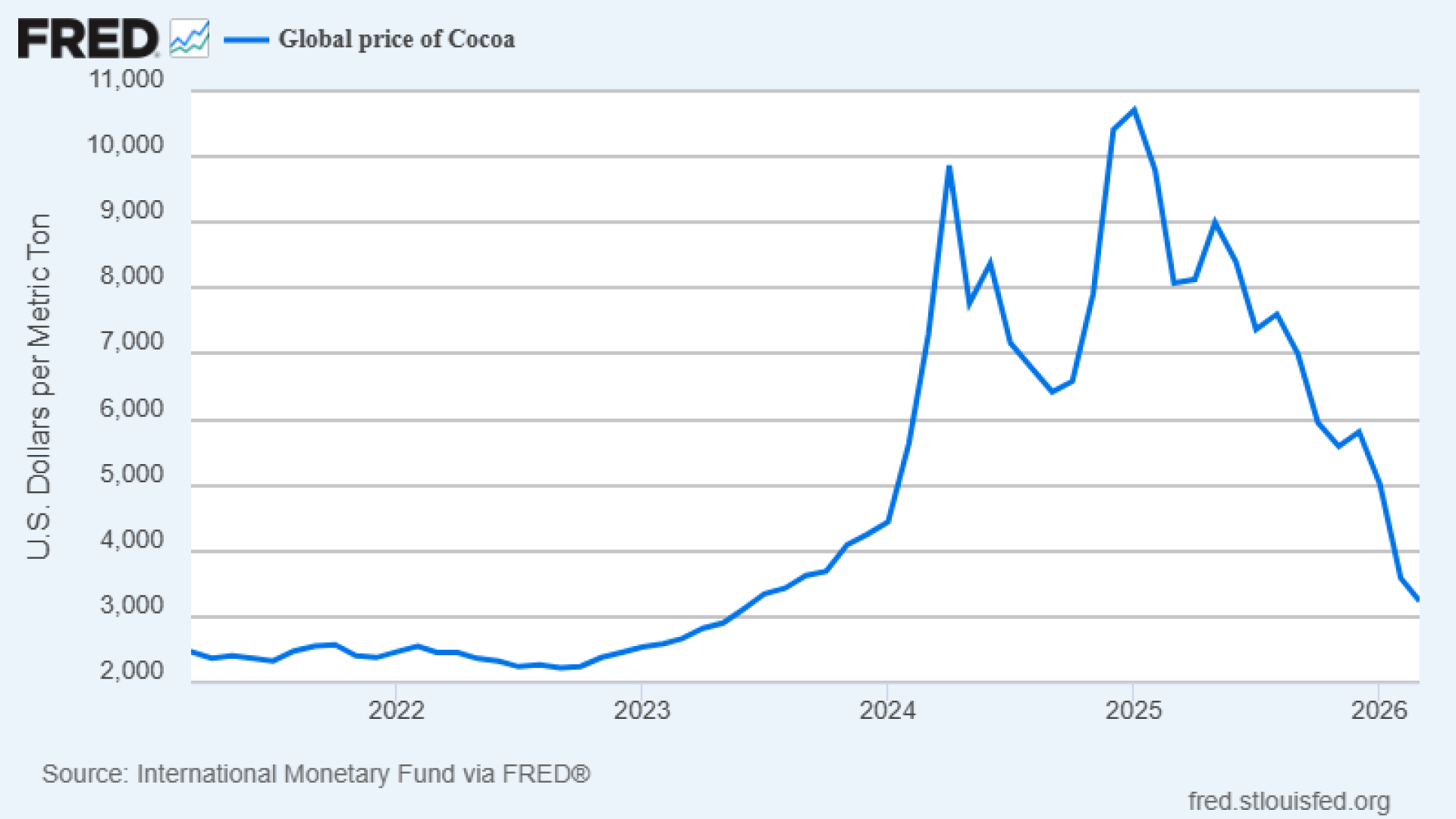
The presumed motive for the reformulation was cost-savings, during a period of duress and price pressure affecting the world cocoa crop. Cocoa prices on the global market rose five-fold from around $2,500 per metric tonne in January 2023 to a peak of $10,700 in January 2025, the International Monetary Fund reports.
While costs settled down since to about $3,200 by last month, chocolate is still more expensive, and confidence in sources of supply has been rattled. A key factor: the cacao bean can be grown successfully in a relatively narrow climate zone, known as the “cocoa belt,” located within 20 degrees north and south of the equator. Roughly 70% of the world’s crop is produced in West Africa, mainly Côte d'Ivoire and Ghana, according to the International Cocoa Organization. The rest is grown in parts of Central and South America and Southeast Asia that enjoy warm temperatures and high rainfall.
Production is labor-intensive and crop yields can be affected by weather conditions – too much or too little rain, as well as plant diseases. The 2024 price spike was a result of all these factors in West Africa, amplified by market speculation.
Mothers of invention
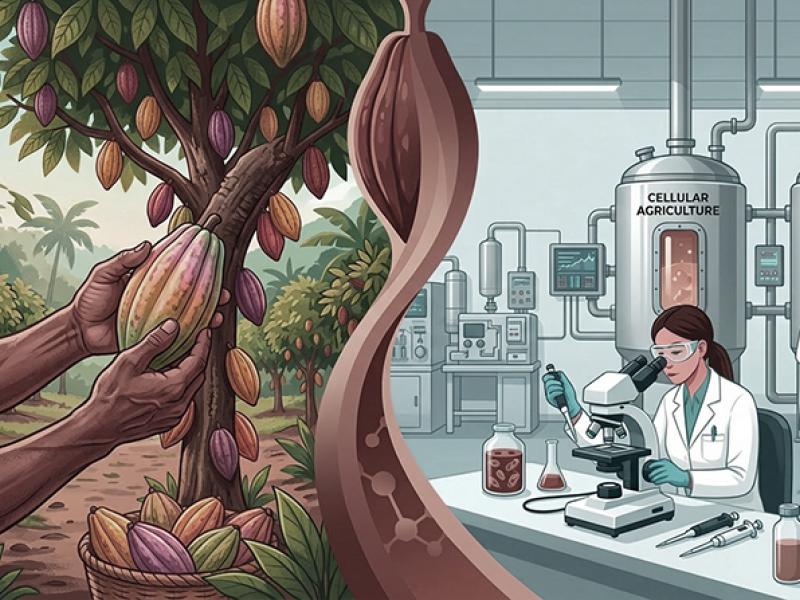
Global demand for chocolate has never been greater, and the perilous status of world cocoa production has motivated inventors to seek ways to produce synthetic, or “lab-grown,” cocoa powder and cocoa butter ingredients. A few are already finding their ways into commercial products, with backing from investors and major global food producers:
- Celleste-Bio, an Israel startup, is producing cell-cultured cocoa butter and cocoa powder in its “bioreactors,” with backing from Mondēlez International.
- Food Brewer, a Swiss startup that produces cultured cocoa made from actual cells, has attracted investment from Lindt & Sprüngli to help it reach commercial scale.
- California Cultured, which makes cultured cocoa using a fermentation process, is working with Belgian ingredients group Puratos to make commercial quantities of cocoa powder.
- Barry Callebaut, the Swiss chocolate maker, said it is exploring cocoa cell culture with researchers at Zurich University.
These new age cocoa-cookers insist that their finished ingredients are biologically equivalent to those produced from field-grown cacao. For commercial producers of chocolate candy and other products, the lure is compelling – consistent quality, reliable supply, predictable costs.
Will chocolate lose its soul?
Not every chocolate substitute is created from cultured cacao cells like the above examples. A variety of other ingredients, ranging from oats to carob to sunflower seeds can be roasted or processed to yield cocoa-like flavorings that have been used in consumer products.
The newer, cell-cultured ingredients promise to be more satisfying because they are actually derived from the cacao plant, then amplified in vats to yield what producers say are true cocoa butter fats, and cocoa powder flavoring.
In the near future we may see chocolate products divide into three tiers: At the top, luxury products sourced from actual cacao plantations, regardless of fluctuating supply. In the middle, the new slew of cell-cultured chocolate and cocoa products which promise to be widely available, consistent and possibly indistinguishable from the all-natural product. At the bottom, cocoa-like flavorings synthesized by processing other plant products.
This leaves the confection industry (and consumer trade regulators) to answer the burning question: “What is real, when it comes to tomorrow’s chocolate?”
As for Hershey, it addressed its ingredients issue at a Mar. 31 investor meeting which was covered by the New York Times. It confirmed that it had reformulated some products substituting cheaper fats for cocoa butter and pledged that all its recipes would return to “classic milk and dark chocolate recipes” by 2027.