As AI Resets the Baseline, Will Your Retail/CPG Tech Measure Up?
Established is a market position. Proven is an operational condition. Baselining establishes the operational condition by measuring what each solution can reliably deliver today before judging the value of what comes next.
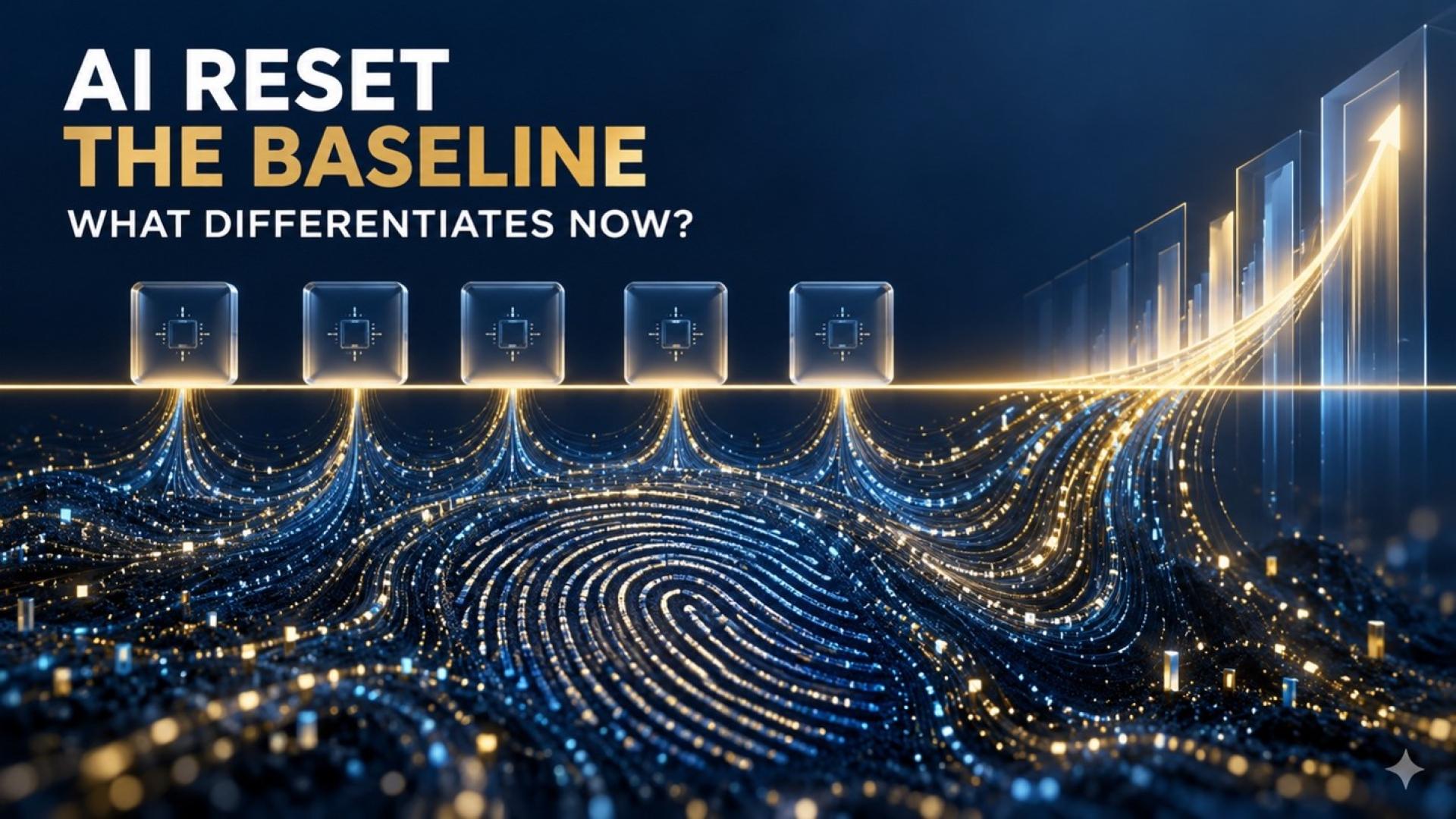
THERE’S NO DOUBT that retail/CPG technology is undergoing a fundamental shake-up.
Market presence, installed base, and longstanding customer relationships – the advantages that allowed large established providers to dominate – no longer provide the differentiation or protection they once did.
A key reason: AI has accelerated solution development. Teams can now build, iterate, and deliver faster than ever. This creates a new Capability Baseline that is narrowing the technology moats formerly enjoyed by established providers. Meanwhile, startups and midsize providers are moving rapidly to expand their capabilities and win customers.
As capabilities become easier to replicate, the data that informs them becomes increasingly valuable and difficult to replicate. What will differentiate solutions now?
The capability baseline re-sets
Many established solutions were designed to solve retail and CPG problems under operating conditions defined decades ago.
The industry now operates under a different set of conditions. Past success does not guarantee present relevance. Announcing a new wave of innovation does not mean it can be delivered operationally. The sooner solution providers recognize this, the better their chances of delivering innovation accurately, repeatedly, at scale, and with speed.
Solution providers must ask not simply, “How do we meet the next target?” but, “How can we create more meaningful value for our customers and advance the industry?” When short-term, internally driven objectives take precedence over customer outcomes, innovation may satisfy the organization’s scorecard without solving the customer’s problem.
Established no longer means proven
At some organizations, retail and CPG traditional solutions may be entrenched because they have been deployed for years, not because anyone has recently verified that they still deliver. Established is a market position. Proven is an operational condition. Baselining establishes the operational condition by measuring what each solution can reliably deliver today before judging the value of what comes next.
Learn more about how CPGMatters incorporates the ARS2 framework in our technology coverage.
AI has not only changed how we can solve problems; it has changed how quickly solutions can be built and brought to market. Yet the early AI surge experienced across the retail technology field may ultimately have done more damage than good.
It created a short-lived sugar rush. An explosion of announcements, features, pilots, and claims that looked like accelerated innovation. Too often, speed of creation has been mistaken for readiness. Technical potential has been mistaken for operational value. Instead of closing the innovation gap, the surge widened the distance between what providers promised and what customers could reliably use.
AI shortened the time required to build something, but it did not eliminate the time and discipline required to prove it.
For many legacy providers, the AI surge created new energy, new narratives, and new capabilities, but the disruption also introduced further misdirection. Providers rushed to demonstrate that they were participating in the AI wave, often without first confronting the limitations of what they already delivered.
For younger innovators, however, AI has created an unprecedented opportunity to disrupt the status quo. What I have seen from many newcomers is genuinely promising. They are addressing persistent industry problems with greater focus, speed, and creativity than we have traditionally seen.
But promise is not maturity. A key question remains. Do these emerging providers have the vision, discipline, and operational maturity to deliver accurately, repeatedly, at scale, and with speed?
Stark choice for retailers and CPGs
So far, much of the progress remains fragmented. Individual solutions may solve important pieces of the problem, but few deliver the breadth, integration, and operational dependability retailers and CPG companies ultimately require. That leaves the industry with a consequential choice.
Will retailers and CPG companies wait for these emerging solutions to mature and deliver sufficient value on their own? Or will they become more agile and entrepreneurial, select the strongest innovations and assemble them into a more effective technology stack?
The next generation of solutions may not come from replacing established providers with newcomers. It may come from baselining what each can actually deliver and assembling the right capabilities around measurable value.
More than ever, data is the differentiator
As AI-enabled functions become widely available, many traditional differences between providers are narrowing. Capabilities that once required years to develop can increasingly be created, replicated, or acquired.
The data behind those capabilities cannot be replicated as easily.
As a result, differentiation is shifting to a place the retail technology industry has not directly confronted in decades. Data quality, relevance, granularity, timeliness, representativeness, and exclusivity will increasingly determine the quality of the solutions it informs. When providers have access to similar AI capabilities, those with better data will generate better intelligence, identify opportunities earlier, and support more relevant decisions.
But differentiated data alone will not guarantee lasting value. The services surrounding delivery, including implementation, integration, workflow alignment, change management, support, and continuous improvement, will determine whether that intelligence produces operational value.
The next competitive divide will therefore not be between solutions with AI and those without. It will be between providers that can combine differentiated data with disciplined delivery and those offering increasingly similar capabilities under different names.
What the industry must prove
To be clear: Our industry should not hold back on innovation. It does need a more honest starting point from which to judge what that innovation actually delivers. Baselining does not diminish what established providers have built or what newcomers are creating. It reveals what each can contribute, where the gaps remain, and whether the next wave of innovation represents measurable progress.
AI has reset the capability baseline. Differentiated data will determine intelligence quality. Disciplined delivery will determine whether that intelligence creates value. The winners will be those prepared to prove the solution, the data and the delivery behind it.

Georges Mirza is the founder of ComTask and a retail and CPG technology innovator who has helped shape the evolution of category management solutions and retail analytics. He has led the development of market-leading solutions widely adopted across the industry and pioneered advances in robotic data collection and image recognition to address critical retail challenges including out-of-stocks and inventory accuracy. Georges is the creator of the ARS²™ Framework, designed to bring greater transparency to innovation maturity by assessing whether solutions can deliver accurately, repeatedly, at scale, and with speed. Today, Georges advises retailers, CPG companies, and technology firms on innovation strategy, solution evaluation, connect with him on LinkedIn or email gmirza@comtask.com