Your Brand’s Next Supply Chain Will Think, Learn, and Decide
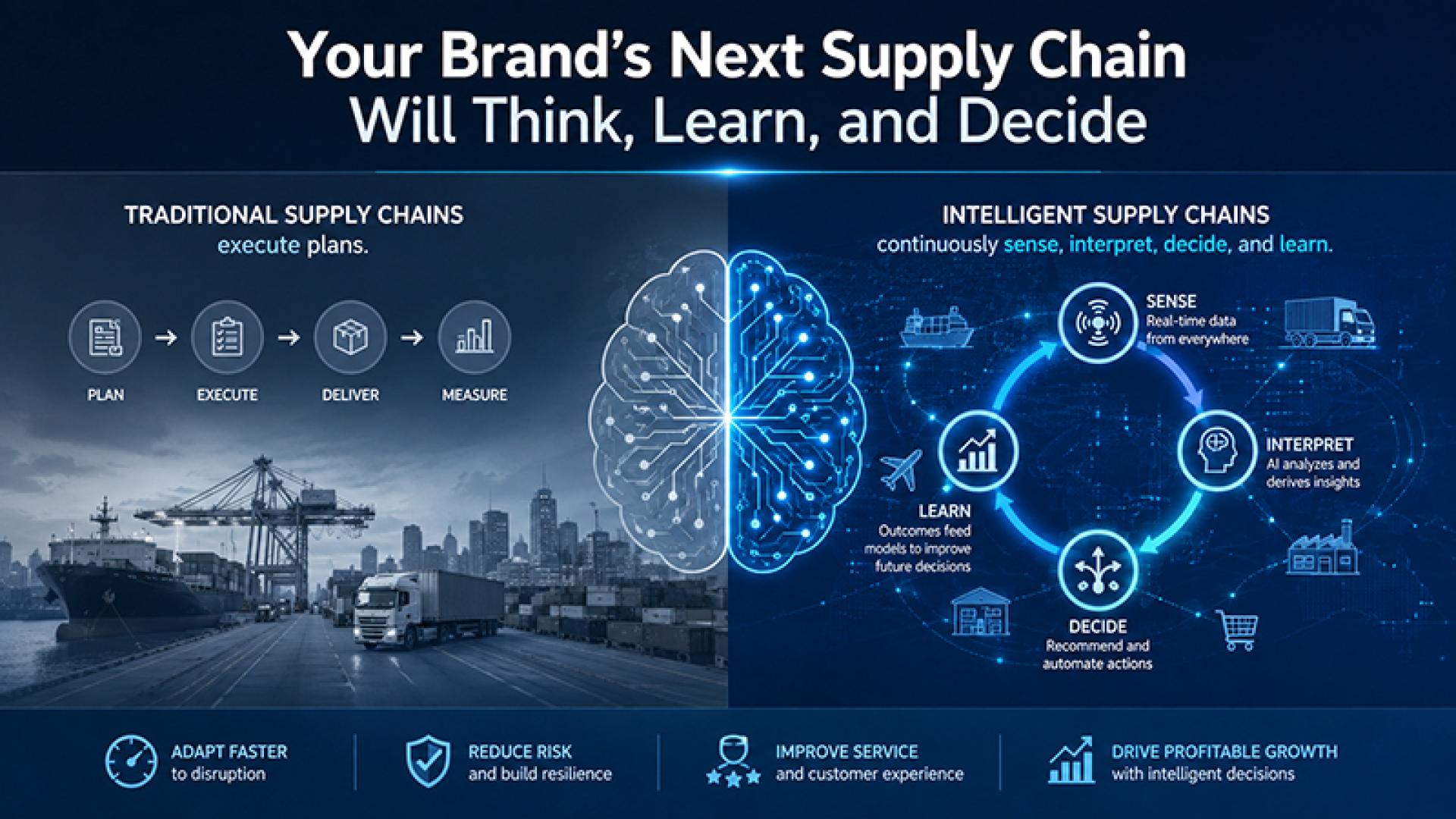
SUPPLY CHAIN EXCELLENCE has been defined for decades by physical scale. Competitive advantage was driven by larger distribution networks, lower transportation costs, greater manufacturing capacity, and leaner operations that separated industry leaders from the rest of the market. Organizations invested billions in optimizing product movement, believing that superior supply chain execution alone would sustain competitive advantage.
Logistical power is no longer the moat that protects brand power. The next generation of market leaders will not be distinguished by the immensity of their supply chains, but by the intelligence embedded within them.
In an environment characterized by volatile demand, geopolitical uncertainty, climate disruption, and increasingly complex consumer purchase and delivery expectations, the decisive supply chain capability is no longer moving products more efficiently. It is the ability to convert every signal into insight, every insight into action, and every action into organizational learning, creating a supply chain intelligence advantage that compounds exponentially over time.
“The age of optimizing supply chains is giving way to the age of orchestrating enterprise intelligence.”
With this transformation in mind, the strategic question has fundamentally changed. It is no longer a question of whether to digitize the supply chain; it is whether the supply chain can become the enterprise's competitive advantage.
The end of the linear supply chain
Traditional supply chains were designed for a more predictable world. Planning cycles stretched across weeks or months. Historical forecasts were sufficiently accurate. Functions optimized their own performances, handing work from procurement to manufacturing, logistics, and commercial teams in a largely sequential process.
That operating model is increasingly misaligned with today's reality. Consumer demand shifts overnight. Extreme weather disrupts production. Geopolitical events reshape sourcing strategies with little warning. Retailers expect higher service levels while reducing inventory. Consumers demand freshness, transparency, and near-immediate fulfillment. Success is no longer determined by the quality of a forecast. It depends on an organization's ability to adapt continuously as conditions evolve.
From execution engine to intelligence engine
This shift represents far more than the adoption of artificial intelligence or advanced analytics. It reflects a fundamental redesign of the supply chain operating model:
Rather than relying primarily on historical demand, intelligent supply chains digest thousands of real-time signals, including consumer purchasing behavior, shelf conditions, supplier performance, manufacturing capacity, transportation constraints, weather patterns, geopolitical events, and commercial activity, to create a continuously evolving view of enterprise performance.
Increasingly, competitive advantage comes from orchestrating the entire interconnected enterprise rather than optimizing individual functions.
- Every production decision influences inventory.
- Inventory affects freshness.
- Freshness shapes customer satisfaction and loyalty.
- Transportation decisions affect sustainability and profitability.
- Supplier performance determines service reliability.
The highest-performing organizations recognize these relationships as strands of a single matrixed system rather than isolated operational activities.
Early leaders are already redefining the model
Several global organizations are demonstrating what this future can look like:
- Amazon continues to expand its intelligent fulfillment network, dynamically optimizing inventory positioning, robotics, labor deployment, routing, and delivery decisions in real time.
- Walmart is integrating AI-powered demand sensing, automated distribution centers, intelligent replenishment, digital supplier collaboration, and real-time shelf intelligence into one of the world's most connected retail operating systems.
- Unilever has embedded integrated business planning across commercial, procurement, manufacturing, and supply chain functions using digital twins, scenario modeling, and advanced analytics to improve resilience and enterprise decision quality.
- Maersk has evolved beyond transportation to become an orchestrator of global logistics, providing customers with end-to-end visibility across increasingly complex trade networks.
- Procter & Gamble continues to synchronize commercial planning, manufacturing, supply chain operations, and predictive analytics through AI-enabled decision support.
None of these organizations would claim to have reached their ultimate destination. They understand that enterprise intelligence is not an end state; it is a continuously evolving capability. Their competitive advantage comes from building operating models that sense earlier, learn faster, and improve with every decision.
Over time, that relentless cycle of learning creates an intelligence advantage that becomes increasingly difficult for competitors to match. What differentiates them is that they no longer view digital transformation as a portfolio of technology projects. They are redesigning how decisions are made across the enterprise.
Technology is the enabler, operating model is the advantage
Many organizations continue to approach supply chain transformation primarily as a technology initiative. That perspective significantly underestimates the challenge. Technology enables intelligent decisions. It does not create them.
The more difficult transformation involves redesigning governance, organizational structures, incentives, leadership behaviors, and workforce capabilities.
- Planning becomes continuous rather than periodic.
- Decision rights move closer to real-time execution.
- Functional silos give way to integrated organizational and operational value streams.
- Decision makers – data scientists, planners, commercial leaders, manufacturing teams, procurement professionals, and logistics experts – increasingly operate as one connected network.
- Leaders don't create advantage by making more decisions; they create advantage by building organizations that make better decisions every day.
For many organizations, this cultural transformation will prove more consequential than any software implementation.
Where leaders should begin
There is no universal blueprint for building a thinking supply chain. Yet the organizations making the greatest progress consistently follow a disciplined sequence of strategic moves that accelerate value creation while reducing transformation risk. The five-stage roadmap below reflects the emerging playbook of market leaders.
- Define a clear enterprise ambition. Intelligence initiatives should be linked directly to measurable outcomes such as revenue growth, resilience, service improvements, lower cost-to-serve, working capital productivity, or sustainability.
- Prioritize a limited number of high-value use cases. Demand sensing, inventory optimization, production scheduling, transportation orchestration, and predictive supplier management often generate measurable results within 12 to 18 months while building organizational confidence.
- Establish a trusted data foundation. Increasingly, next-generation shelf intelligence, connected manufacturing, supplier collaboration, logistics visibility, and commercial data create the enterprise operating picture required for intelligent decision-making.
- Redesign the end-to-end operating model. Without changes to governance, incentives, and decision rights, technology simply automates existing complexity.
- Invest as aggressively in people as in platforms. AI literacy, systems thinking, scenario planning, advanced analytics, and cross-functional collaboration will increasingly distinguish organizations that can convert information into competitive advantage.
Build your intelligence flywheel
The next competitive divide will not be measured in percentage points; it will be measured in learning speed. Organizations that learn faster will separate faster.
Unlike traditional productivity programs, intelligent supply chains improve with experience. Every disruption strengthens future resilience. Every decision improves subsequent decisions. Every operating cycle expands organizational knowledge. Over time, this creates an intelligence flywheel.
By 2035, the most advanced supply chains will function less like logistics networks and more like self-improving enterprise operating systems. They will continuously sense demand, anticipate disruption, orchestrate decisions across complex ecosystems, and improve performance with every interaction. That capability will define the next era of leadership in the food and beverage industry and increasingly across every retail sector.
Organizations that transform their supply chains into adaptive enterprise intelligence systems will consistently make better decisions, respond faster to market changes, lower their cost to serve, and strengthen resilience with every operating cycle. As intelligence compounds across the network, competitive separation compounds with it.
The defining question for executive teams is no longer "How efficient is our supply chain?”
It is far more consequential: “How intelligent is your supply chain?”
 Thom Blischok serves as Chairman and CEO of The Dialogic Group, LLC, where he provides strategic guidance to leading retailers, technology innovators, consumer packaged goods companies, and investment firms specializing in retail transformation, artificial intelligence/robotics, operations, and consumer engagement