Your Plan Got Faster. Your Shelf Did Not.
RESEARCHERS at the University of Texas and Harvard Business School studied 46 million worker shifts across 500 grocery stores. They found that store managers override 72.9 percent of the labor schedules the algorithm hands them. That number alone would make most executives reach for a compliance program.
Read the second finding first. Overriding raised labor productivity by 5.7 percent. The managers were right. They hold knowledge about their store that the algorithm treats as a fixed constraint, and they spend their day reconciling a plan with a building.
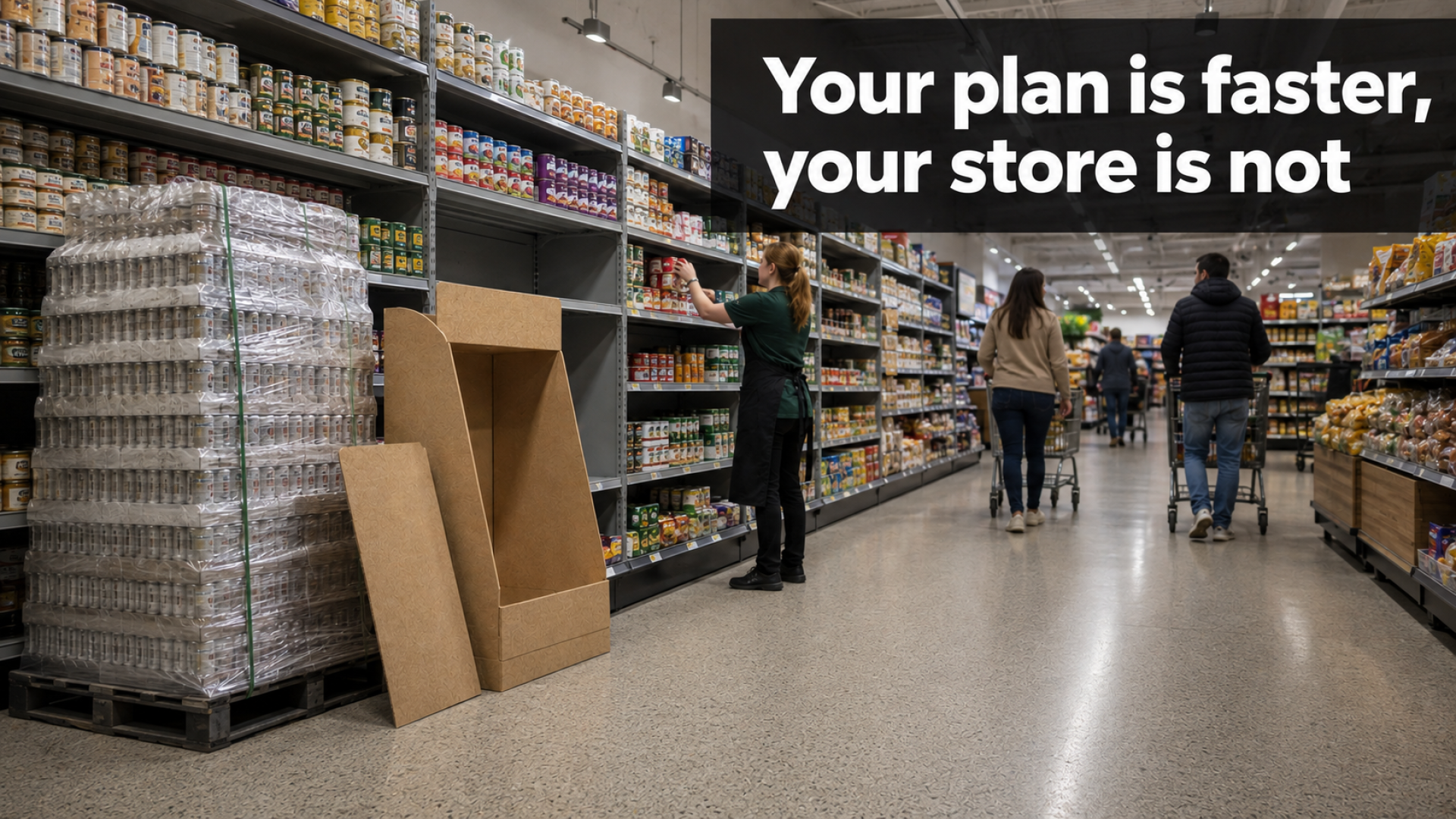
Your display sits in that building. So does your promotion, your planogram, and the new item you fought nine months to land. Every one of them arrives as a plan and has to survive a person with a cart of tasks and a shift that ends.
As plans accelerate, capacity lags
Planning technology has moved quickly. Store capacity has not moved at all.
McKinsey surveyed 114 merchants in December 2025 and found that 71 percent report AI merchandising tools have had limited to no effect on their business so far, and that merchants still spend 40 percent of their time on low value work and reconciling data across disconnected systems. BCG surveyed 350 retailers seven months earlier and landed on the same 40 percent. Two firms, two samples, one number. The tools got faster. The people did not get freer.
Now look at who actually touches the shelf. SPAR Group, a publicly traded merchandising provider, reported in its 2025 annual filing that in store labor was 84.1 percent of its cost of revenue. Advantage Solutions employed roughly 73,000 people at the end of 2025, of whom 57,000 work part time, and its full-time headcount fell while its total headcount rose. US retail average weekly hours ran 30.0 in July 2026 against 34.3 for the total private sector, according to the Bureau of Labor Statistics.
That’s the store labor picture everyone is experiencing and it will only get thinner every year, and it is the only layer that moves product from a back room to a facing.
More plan produces more deviation
Here is the mechanism most planning conversations skip.
Caro and Saez de Tejada Cuenca studied price setting inside Zara's own stores and published the result in Manufacturing and Service Operations Management in 2023. When managers had a higher number of prices to set, they were more likely to deviate from the system recommendation. Volume of decisions predicted departure from the plan.
The same pattern shows up in the inventory record. Rekik, Oliva, Glock and Syntetos examined roughly 24,000 items across 11 stores and found that record inaccuracy rises with restocking frequency. More activity at the shelf corrupts the number faster.
Put those two findings together and you get an uncomfortable math. Doubling the number of plans you push into a store does not double execution. It raises deviation, degrades the data the next plan is built on, and quietly widens the gap between what the system believes and what the shopper sees.
The size of the prize is at the shelf
The shelf became the constraint a long time ago, and the research says the same thing every time someone measures it.
Gruen and Corsten, in work funded by Procter and Gamble and supported by GMA, FMI and NACDS, found that 75 percent of out-of-stock causes traced to store practices rather than upstream supply, and that a quarter of out-of-stocks were products sitting inside the store but not on the shelf. DeHoratius and Raman examined nearly 370,000 inventory records across 37 stores and found 65 percent of them inaccurate. On display execution, the most transparent measurement the industry has produced remains the POPAI and Quri compliance work built on more than 5,000 store observations, which found that on average roughly half of stores had the planned display executed as the manufacturer specified. That study also found that 79 percent of retailers simply assume their displays are being executed.
Those studies are old. The industry measured this problem carefully, published the answer, and then spent two decades investing almost entirely upstream of it.
The upside is certain. In the same 2025 study, a straightforward inventory audit produced an 11 percent store wide sales lift, concentrated entirely on the items where physical stock exceeded the record. Product that was already bought, already shipped, and already paid for. It was simply invisible to the replenishment system that decides what gets ordered and what gets filled.
What to ask before you fund the next plan
Three questions change the conversation, and none of them require new technology.
Ask your retail partner what execution capacity exists in the weeks you are buying. Not whether the display will ship. Whether the labor hours exist to set it, and who is counting. Fund fewer events with confirmed capacity behind them rather than more events with none.
Ask what the plan costs to execute. Assortment shapes demand, demand shapes buying, buying shapes what arrives at the back door, and what happens in the next 20 feet decides whether any of it reaches a shopper. Almost no planning system prices those 20 feet. A team at Lowe's publishing its own space optimization work listed operational switching costs from planogram changes as future research. When a major retailer's own scientists name it as unsolved, the rest of the industry can stop pretending it is handled.
Ask who audits the shelf and how often. The 11 percent sits there.
None of this argues for slower planning. It argues for pacing the plan to the capacity that has to carry it, and for spending the next dollar on the last 20 feet rather than the first mile. Build the plan the store can actually keep, and every display on that floor is there for a reason, and the reason is the shopper who finds it.
 Kevin Sterneckert is VP of Strategic Alliances at RELEX Solutions. Over 25 years he has worked retail planning from three sides: as a practitioner running pricing and merchandising decisions, as a solution provider building the software behind them, and as a Gartner analyst covering the market. He writes Retail Planning Intelligence on LinkedIn.
Sources:
- Kwon, Raman and Tamayo, Human Algorithm Interactions in Labor Scheduling Decisions, working paper under review at Management Science, 500 stores and 46 million shifts.
- McKinsey Global Merchant Survey, fielded December 2025, 114 merchants.
- BCG, What 350 Retailers Say About the Future of Merchandising, May 2025.
- SPAR Group Form 10 K for fiscal year 2025.
- Advantage Solutions Form 10 K for fiscal year 2025.
- US Bureau of Labor Statistics, Employment Situation, Table B 2, July 2026.
- Caro and Saez de Tejada Cuenca, Believing in Analytics, Manufacturing and Service Operations Management, 2023.
- Rekik, Oliva, Glock and Syntetos, inventory record inaccuracy in grocery retailing, 2025 preprint, approximately 24,000 items across 11 stores.
- Gruen and Corsten, A Comprehensive Guide to Retail Out of Stock Reduction in the Fast Moving Consumer Goods Industry, funded by Procter and Gamble with GMA, FMI and NACDS.
- DeHoratius and Raman, Inventory Record Inaccuracy, Management Science, 2008.
- POPAI and Quri Compliance Initiative, reported January 2015.
- Bhattacharyya and colleagues, OPTIMUS, Lowe's optimization team, 2026.