Brands Count on Data Flows from Connected Stores
THE ONGOING TRANSFORMATION of physical stores into digital communication environments carries with it a cascade of implications for brands.
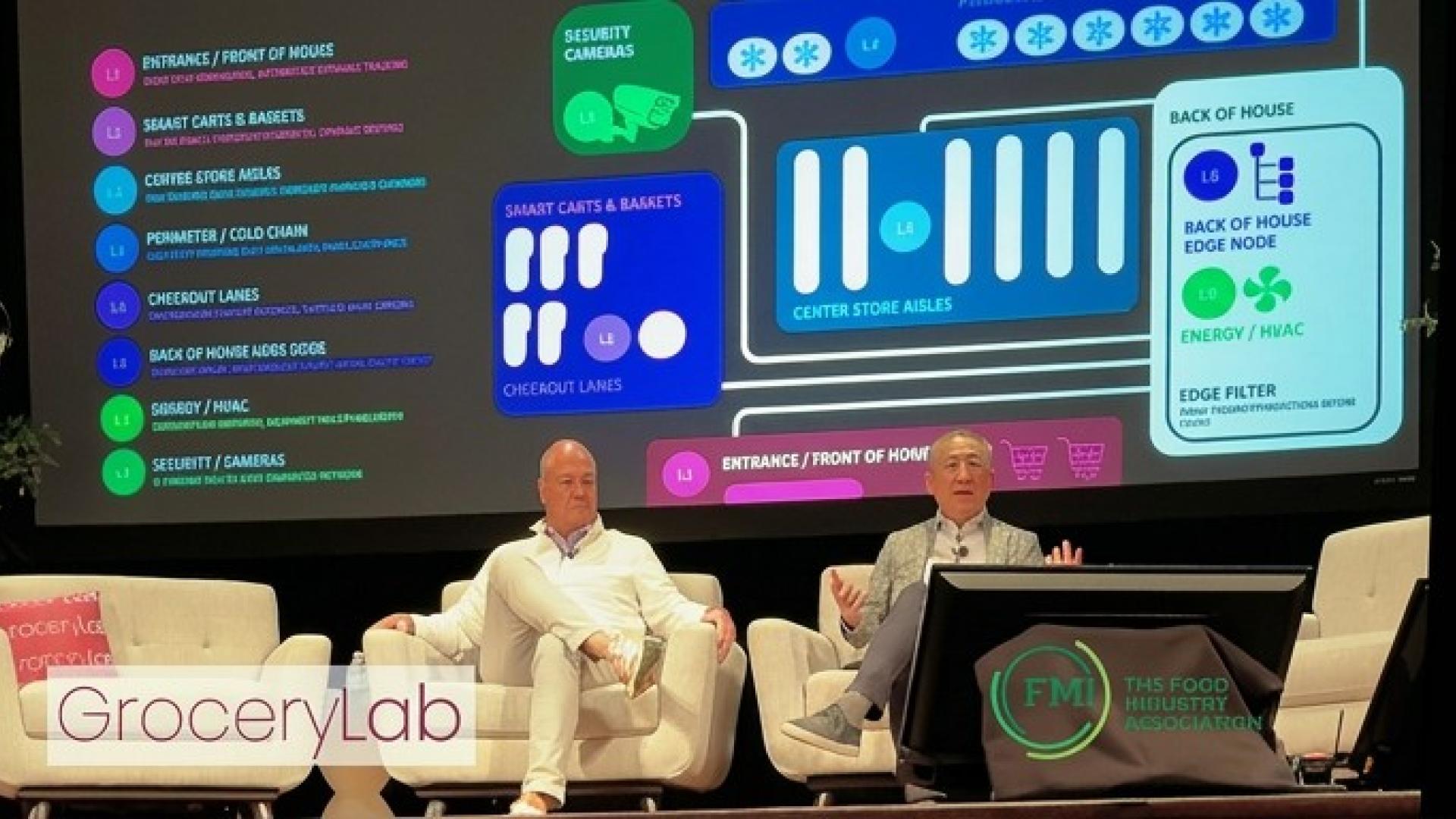
It certainly presents challenges for their retail partners too. In a session at the recent GroceryLab event hosted by FMI – The Food Industry Association, John Tonthat CRO of systems integrator Cellhub and Mike Parker, T-Mobile Senior Manager – Enterprise Solutions Engineering – Southeast, addressed the complexity retailers face as they implement digital sensing throughout the retail enterprise.
Their session, “Connected Shopper Architecture,” took place at the Gem Theater in Detroit, Michigan.
Further information about the recent FMI GroceryLab event is available here:
“If you want to have data at the very end to be able to aggregate, to be able to analyze, you have to start with a structural foundation that connects all of the things inside of your store and equally as important, outside of your store,” Tonthat said.
He identified eight distinct “telemetry” points that exist inside a modern retail store:
- Entrance/Front of House
- Smart Carts and Baskets
- Center Store Aisles
- Perimeter/Cold Chain
- Checkout Lanes
- Back of House / Edge Node
- Energy/HVAC
- Security/Cameras
Each of these touchpoints has potential to deliver a flow of data relevant to retailers and their brand partners, ranging from shopper demand, to store traffic, inventory status, merchandising execution and more. All these data flows can be material to category management and logistical decisions.
“Unfortunately today, it's not connected,” Tonthat said. “How do we stitch together that fabric of connectivity that provides the telemetry you need to provide a better both employee experience and customer experience?”
Parker of T-Mobile addressed the technical foundation that retailers are establishing within stores to enable this: “If you think about the first layer of network connectivity, it's obviously availability. You need to have the connection. You need to have the resilience, need to have security and then simplify.”
Achieving ‘Three Nines’
He referenced an industry standard for network uptime, commonly referred to as three nines, which means 99.9% availability.
“Three nines sounds pretty good. It's basically 43 minutes a month where you're potentially down. And I think most people in retail can live with that. Where it starts to get tricky is where you have multiple ISPs, multiple connections, multiple cloud services, multiple applications, devices everywhere, that's where the SLAs [Service Level Agreements] never seem to line up.”
When it comes to the communications platform in stores, Parker defined four dimensions where his company advocates close attention:
- Redundant Connections. Secondary paths to keep operations running during outages. “Sounds obvious, but it's not obvious everywhere. You have to have a plan B.”
- Cloud-Managed Visibility. Centralized insight into devices, apps, and connections. “You can't fix what you can't see. It puts you in a good place to start off or to check what you have today.”
- Secure Configurations & Monitoring. Protect endpoints with policies and proactive monitoring. “No matter what it is, whether it's a scanner, whether it's a camera, whether it's a cart, whether it's a label, those things are typically the weakest link.”
- Simplified Support. Streamlined updates and support to reduce risk. “Sounds hard when you are bringing all these things together.”
Those four pillars support the full range of activities across the retail enterprise, he added. Store operators, employees, suppliers and shoppers all tap into a common network environment to enable their activities.
Parker said that T-Mobile continues to add network capabilities to support improved connectivity and reliability for its 5G network, approaching the “four-nines” level.
“That's where the shopper experience starts,” Tonthat said. “As they follow you all the way into the store, the connectivity layer that's consistent is the cellular connection.”