Panning for Gold in the FMI Speaks 2026
BRINGING GROCERY PRODUCTS TO MARKET is an intricate activity for suppliers and their retail partners. It encompasses joint activities and decisions so numerous and interconnected that a clear understanding can be elusive for practitioners.
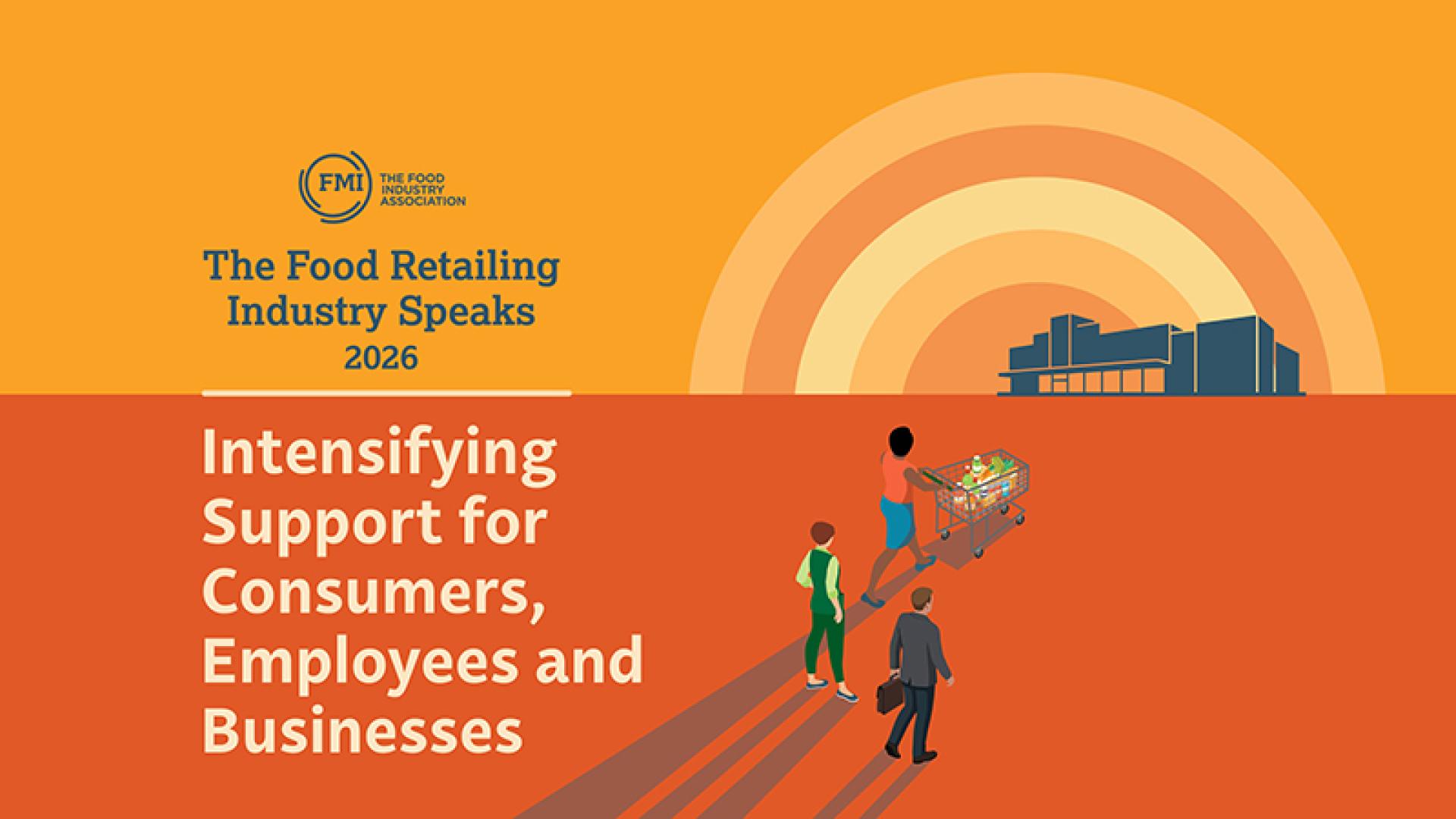
That’s why we welcome the publication this month of the latest The Food Retailing Industry Speaks 2026, which continues a 77-year tradition of researching, sifting and clarifying the facts about these business practices from FMI—The Food Industry Association.
This year’s report, subtitled, “Intensifying Support for Consumers, Employees and Businesses,” is impeccable, as we have come to expect. It reports on extensive research with retailers and suppliers that yields important trends and benchmark findings.
The study authors define five strategic areas for success across the food industry. All will be relatable to professionals across the CPG sector:
- The macro landscape. Industry responses to economic, geopolitical, security, and regulatory considerations.
- Customer needs. Solutions for health, nutrition, value and community that enhance customer engagement and feed families.
- Shopper experiences. Action steps for optimizing product offerings, omnichannel shopping, stores, services and overall quality.
- Technology adoption. Evolving data analytics, solutions and tools that empower operations, ecommerce and engagement, including artificial intelligence and robotics.
- Business resiliency. How a retail industry with 2.1% net profit margins competes to serve consumers, to support workforces and to deliver healthy financial outcomes.
Within, there’s a wealth of detail about how retailers pursue these goals on their own and in concert with supplier partners. Of course, as CPGMatters Storyteller-in-Chief, I dug especially into the findings of concern to the CPG brand marketing community. A close read reveals several golden nuggets for consumer brand suppliers that are worth highlighting here.
Supplier adoption of AI and data analytics continues to outpace retailers
New tech is being rapidly adopted among trading partners, but grocery suppliers are generally further along than retailers when it comes to implementing them.
In the Speaks survey, 100% of suppliers say they presently use artificial intelligence in some business capacity, compared with 93% a year ago. AI adoption by retailers lags but is growing rapidly too. At present 68% of retailers confirm use of AI, up from 47% a year ago.
Generative AI (large language models) have been adopted by 80% of suppliers for marketing activities, while 53% use them for internal content creation. We can imagine brand teams turning out social and retail media assets using these tools, to keep pace with accelerating messaging demands.
Suppliers are adopting AI applications for demand and production planning at rapid pace too, with 69% reporting their use last year and 25% indicating they are on the roadmap for 2026.
Other AI tools in use by CPGs are assortment planning and replenishment, cited by 60%, and supply chain logistics, by 67%.
Promotional performance management software for merchandising or ecommerce is widely deployed, with nearly one in four suppliers (73%) indicating use in 2025 and another 20% affirming plans to adopt this year.
Promotional investments span media types
Respondents reveal a widening use by suppliers of social and influencer marketing to create awareness and pre-shopping demand outside the retailer’s “walled garden”.
They are making the most use of Facebook (80%), Instagram (80%), influencer strategies (80%), in-store signage (75%), digital circulars (75%), email (70%), in-store-only promotions (70%), retail media networks (70%) and television ads (70%).
Note that involvement in social and influencer strategies exceeds the use of RMNs or TV, but this survey does not indicate relative spending levels.
In this context, the broadening use of influencer marketing to drive product discovery and interest seems worthy of special note. The techniques have become widespread as large CPG companies shift budgets in this direction, and some engage hundreds or even thousands of independent creators who make reels and reviews for their followers.
Locally sourced and better-for-you items expand share
Most responding food retailers (87%) indicate that they incorporated locally sourced SKUs throughout the store as a strategy for differentiation in 2025. 67% say they plan to increase this activity.
Suppliers are also cognizant of consumers’ increasing prioritization of healthy options, with half of suppliers noting that this change is positive for their businesses. 76% of suppliers focused on products with beneficial attributes for health and well-being, and 67% of those suppliers reported success.
CPG product planners should take note that about half of retailers are devoting more SKUs to organic produce and organic products overall, as well as to nutrition, health and wellness items. Meanwhile, retailers anticipate increases in specialty or imported products (47%), allergen-friendly products (42%) and gluten-free items (38%).
As retailers adjust assortments to meet consumer preferences, this presents both strategic challenges and opportunities for brand marketers.
More suppliers than you might think co-pack private brands
Adding to the competition for shelf space, many retailers (58%) plan to carry an increased number of private brand items in the year ahead. This is no secret and a continuation of recent trends.
What may seem unexpected is how many brand suppliers also do private-brand manufacturing. Nearly half (48%) say they did private-brand co-packing in 2025 and 50% rated the activity as successful (8 or higher on a 10-point scale).
This choice may seem counter-intuitive considering that brands confront private label products as a competitive challenge at the shelf, but there may be alternative considerations in play. Idle manufacturing capacity doesn’t make money. Making own-label products for valued retail or wholesale partners may bring a better total return on invested capital.
Viewed in the context of the entire joint business relationship, it may be the pragmatic option to provide a retail partner with own-label product, versus conceding the volume to another supplier.