Aisle Disruption: Tech and Regulation are Remaking the Laundry Category
FOR LAUNDRY PRODUCT GIANTS like Unilever and Procter & Gamble, plastic jugs are giving way to less bulky product forms designed for optimum performance in modern clothes washers.
For decades, brand leaders relied on a predictable playbook for the laundry category: incremental fragrance innovation, periodic price adjustments, and the securement of physical shelf real estate. As we move through 2026, that playbook is effectively obsolete.
The category is currently being redefined by a “pincer movement” of regulatory pressure on Scope 3 emissions and the rise of digital gatekeepers—specifically smart appliances that now dictate brand choice via auto-dosing algorithms.
Recent performance data from industry leaders like P&G and Unilever confirms that organic growth is no longer driven by clean alone, but by a brand’s ability to integrate into a wider technological and environmental ecosystem.
For CPGs, the strategic mandate for the next 24 months is clear: shift from selling a liquid commodity to providing a high-margin, tech-integrated service. This requires a radical realignment of R&D and supply chain priorities as well as leaning on AI to push innovation boundaries and lessen time to market.
Procter & Gamble launched television advertising for Tide evo, a flexible, 3-inch white square made from compressed detergent fibers rather than heavy liquid or bulky plastics. Ads ran during several 2026 FIFA World Cup matches in the first round.
Market leaders have already begun making changes. Unilever, for instance, is leveraging AI to innovate faster and accelerate its speed to market. According to Eduardo Campanella, Business Group President, Home Care, these efforts include predictive maintenance, real-time demand planning, intelligent mixing systems and energy optimization.
“We are also growing our Home Care sites that are part of Unilever’s digital twin network—a replica of our factories—that enables continuous production monitoring, analysis and simulation of changes before implementation,” Campanella stated in the company’s most recent annual report.
Other supply chain areas of focus for Unilever are vertical integration and direct-to-customer dispatch models. Campanella said by producing key materials like surfactants and designing fragrances in-house, Unilever able to improve its supply resilience and secure long-term cost benefits.
“We are co-locating distribution centers with factories, enabling faster, more direct deliveries to customers,” he noted.
P&G Takes a Blended Approach
For officials at P&G, a mix of old and new defines its approach to market in 2026. Beyond surveys and focus groups, P&G officials use advanced tools such as its Connected Home platform, where participating households opt-in to share behavioral insights via smart sensors, offering the company a deeper understanding of daily routines.
“It’s about staying continuously connected to consumers and bringing that perspective into decisions across the business,” said Kirti Singh, Chief Analytics & Insights Officer at P&G. For company officials this means looking beyond surface-level consumer behavior.
“By focusing on the problem consumers are trying to solve and what feels ‘worth it’ to them we can use this to create better choices and superior experiences,” he stated.
Singh said P&G’s ability to drive consumer insight at scale is further strengthened by AI-enabled tools, accelerating insight generation and enhancing its capability to analyze large sets of data with precision. “This helps to ensure that consumer understanding is continuously woven into our decision-making throughout the entire product lifecycle.”
Five Trends Shaping the Future of Laundry Care
From the active-care needs of technical fabrics to the logistical necessity of ultra-concentration, the following five trends represent the new survival requirements for 2026 and beyond.
1. From Basic Clean to Fabric Longevity
As consumer spending on technical apparel and luxury athleisure reaches new highs, the laundry room has become a preservation center. Consumers are no longer washing to remove dirt; they are washing to protect an investment.
This shift allows brands to abandon the “race to the bottom” on price. High-performance enzymes that offer fiber-strengthening and anti-pilling properties are enabling “Super Premium” tiers that command double-digit margin increases.
To remain a top choice, suppliers will need to pivot R&D from aggressive surfactants toward protective polymers.
Henkel, in its recent strategic updates, has emphasized its move toward “active-care” and 100% biodegradability as a core pillar of its growth strategy.
2. The Cold-Water Mandate
The “Cold Water Revolution” has shifted from a green marketing niche to a corporate survival strategy. With 2030 ESG (Environmental, Social, Governance) targets looming, major retailers are increasingly auditing the “in-use” carbon footprint of the products they carry.
P&G has been a vocal leader here, with its 2025 Annual Report noting that 9 out of 10 of its product categories grew organic sales through “consumer-first excellence” that includes high-efficiency cold-water innovation. For leadership, this is a regulatory hedge: products that perform at 20°C (68°F) are the key to reducing Scope 3 emissions without requiring a change in consumer infrastructure.
Given this, more suppliers are expected to prioritize “low-temp” stability. The goal is a formula that delivers a “torture test” clean—like P&G’s recent focus on “Skip the Soak” technology—while maintaining a chemical profile that doesn’t require heat to activate.
3. Securing the Software Shelf
The most dangerous threat to traditional grocery slotting isn’t a private label—it’s the auto-dosing washing machine. As Samsung and LG continue to dominate the smart appliance market, the detergent “refill” is increasingly decided by a machine’s algorithm rather than a shopper’s eyes.
The laundry room is now part of the Direct-to-App (DTA) economy. If your brand isn’t the “preferred cartridge” for an OEM (Original Equipment Manufacturer), you have effectively lost the shelf.
From Shelf-Set to Handset:
Many consumers will likely discover their next laundry purchases when their connected device tells them when and what to buy.
With this in mind, marketing teams have begun shifting focus from physical end-caps to IoT partnerships. The new “slotting fee” is a software integration deal with appliance giants. To compete, suppliers are investing in proprietary cartridge designs that offer high-precision dosing, making them the “official” choice for smart-home ecosystems.
4. Logistical Slimming
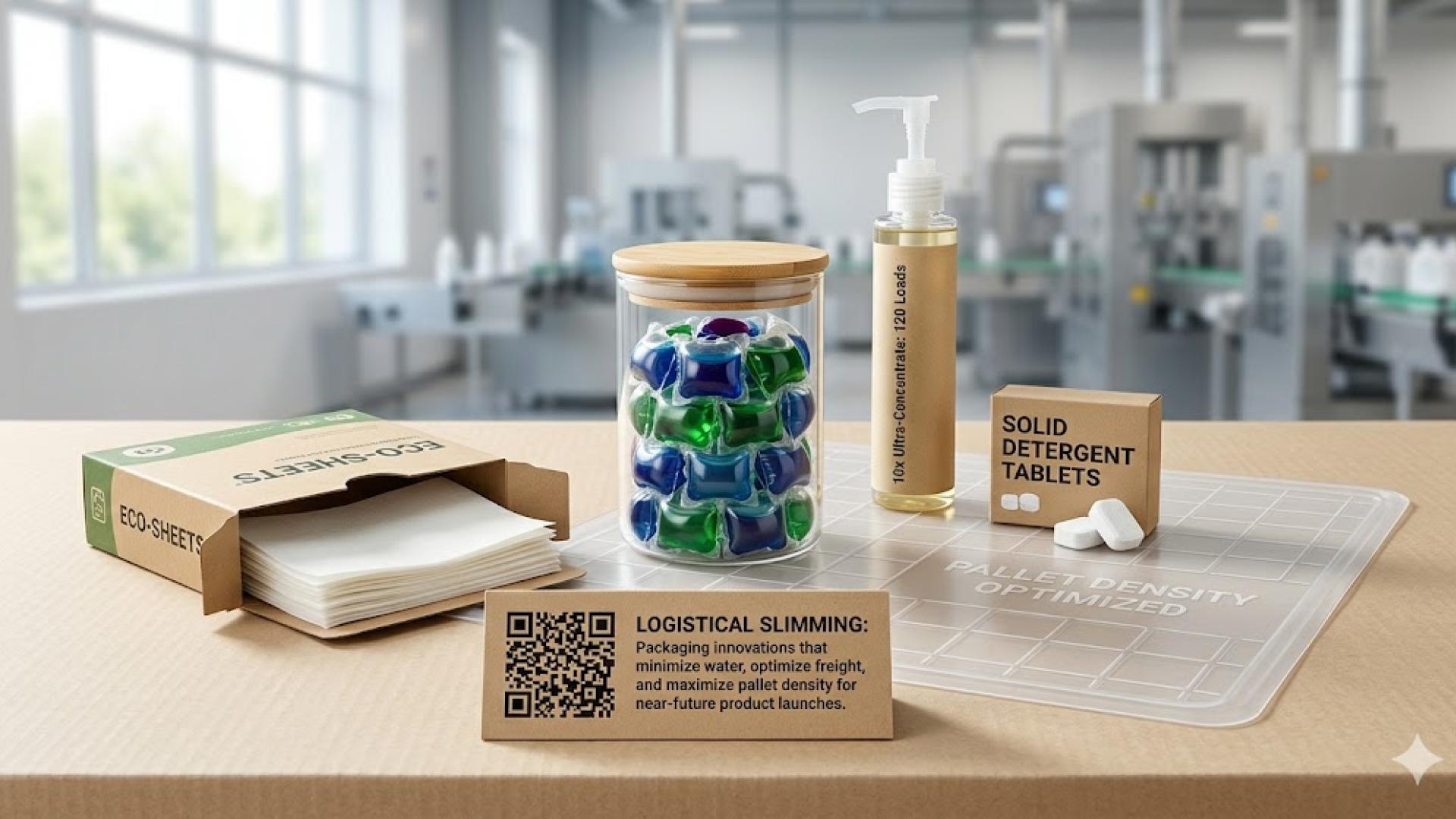
The transition to waterless formats—sheets, ultra-compact pods, and 10x concentrates—is finally hitting mass scale. While the environmental “plastic-free” story is strong, the real story is the optimization of the supply chain.
Shipping water has always been a massive drain on the P&L. Ultra-concentration allows for a radical increase in pallet density. As Unilever highlighted in its 2024 Annual Report, the push toward sustainable, concentrated formats is a primary lever for managing the volatile costs of freight and warehousing.
This is a call to action for packaging and logistics partners. The future is a “diminished footprint.” Suppliers who can provide stable, high-potency “sheet” technology or waterless solids will be the primary beneficiaries in the drive toward “logistical slimming.”
5. Hygiene as a Permanent Sub-Category
The “Post-Pandemic” consumer remains hyper-aware of invisible pathogens. This has transformed laundry sanitizers from a niche additive into a multi-billion-dollar category fixture.
Clorox data shows that while volume in some legacy categories has normalized, the demand for hygiene-centric products remains a resilient pillar of their performance. For suppliers, this represents a “basket-builder”—a secondary product that doesn’t cannibalize the main detergent but adds significant incremental value.
Data shows the sub-category is trending toward botanical disinfectants and high-performance polymers that offer 99.9% bacteria kills without the fabric damage associated with bleach. The “win” here is a product that smells like a premium fragrance but acts like a clinical disinfectant.
The Pipeline Perspective
The common thread across these five trends is a permanent intersection of environmental compliance and operational efficiency. For brands planning pipeline development and product launches for the 2027 horizon, the investment strategy must pivot immediately.
Growth is no longer found in traditional category expansion, but in the seamless integration of chemistry and software. Brands and suppliers who ignore these market realities to focus solely on "bulk and bleach" face rapid margin erosion and shelf obsolescence.
Conversely, organizations that actively invest in performance, protection, and digital partnerships will secure their dominance in the automated laundry rooms of tomorrow.