The Fifth Trait Missing from Successful Innovation
INNOVATION has advanced faster than at any other point in retail/CPG technology history over the past decade. Yet trust has moved in the opposite direction.
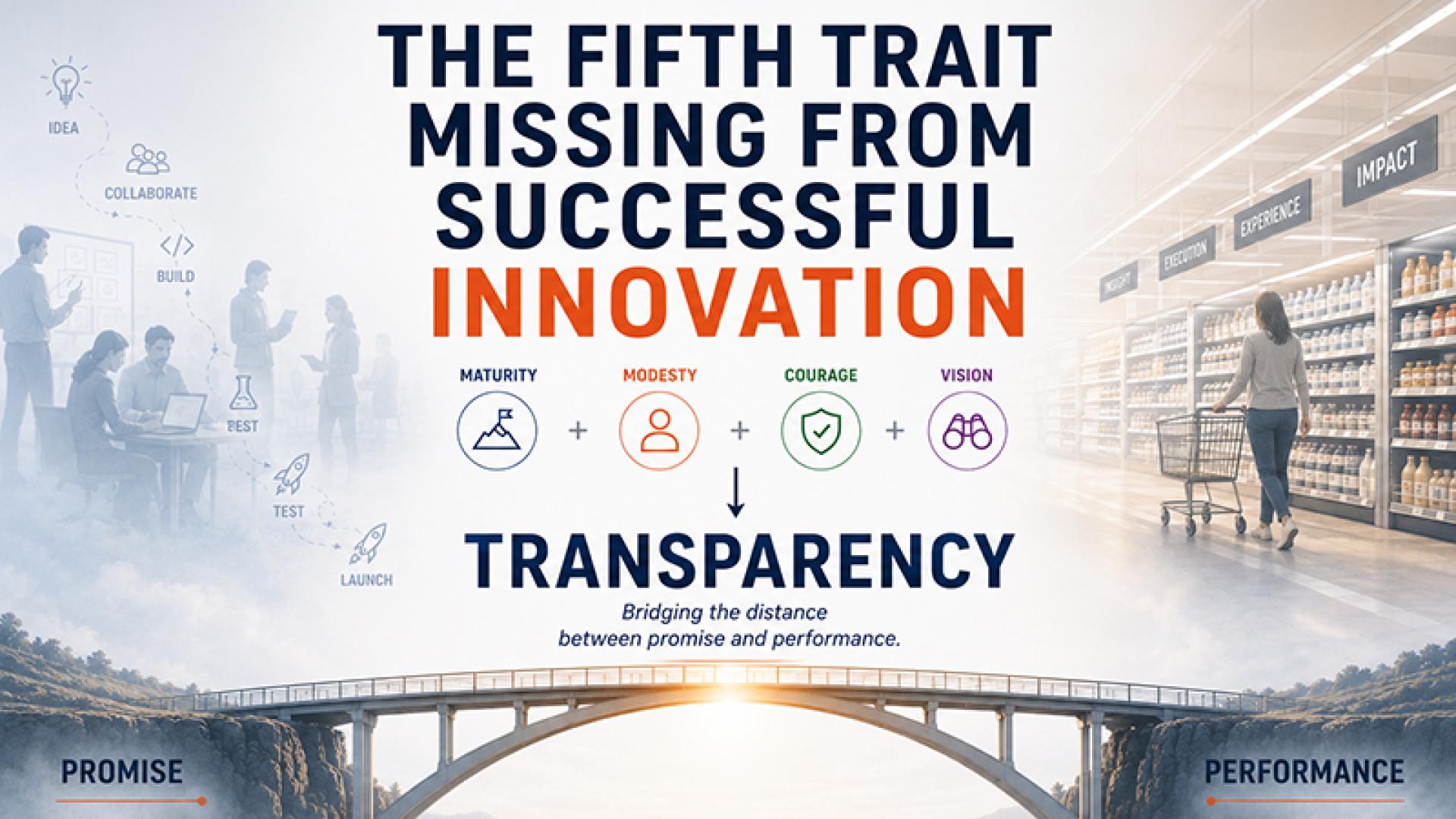
Several years ago, I wrote that successful startups shared four characteristics: maturity, modesty, courage, and vision. At the time, I was focused on what differentiated companies that ultimately succeeded from those that struggled. Since then, after working with startups, global technology companies, retailers, and CPG organizations, I have come to believe there is a fifth characteristic that may be even more important: Transparency.
- Maturity means understanding limitations and making disciplined decisions.
- Modesty is the humility to recognize that innovation is a journey rather than a destination.
- Courage is the willingness to confront difficult truths and persist through setbacks.
- Vision provides direction for what the solution can ultimately become.
Looking back, those four traits remain essential, but experience has convinced me they are not sufficient on their own.
Recognize the transparency gap
Retail technology is experiencing extraordinary innovation. Artificial intelligence, computer vision, robotics, automation, and advanced analytics have transformed what is technically possible. At the same time, expectations have risen even faster than demonstrated capability.
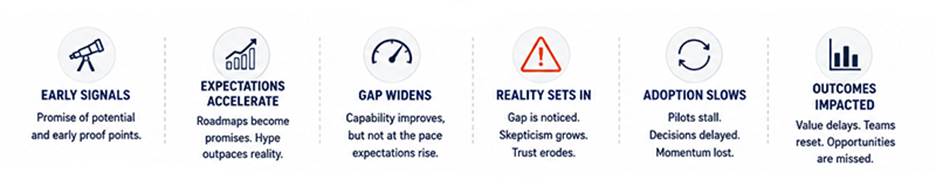
Competitive pressure, investment, media attention, and the race to establish market leadership have encouraged organizations to communicate future potential as if it were present-day reality. Roadmaps became promises, pilot results became production expectations, and isolated successes were often interpreted as evidence of broad market readiness.
The rapid advancement of AI has accelerated both innovation and expectations, making it increasingly difficult for customers to distinguish between what has been consistently demonstrated in real-world operations and what remains under development. As the gap between expectations and reality widened, so did skepticism, creating a trust deficit that now affects the adoption of innovation across the industry.
The common thread that I have seen surface as a missing component in the adoption of innovation over the past decade is transparency. The days of working in stealth mode and secrecy are long gone. Yes, there is a period early on in the process that requires verification and validation, but when it is done, it is never too early to get ready for go-to-market.
Transparency begins inside an organization. External transparency is difficult to sustain if engineering, product, sales, and leadership operate from different understandings of the solution's current maturity.
Confront the innovation transparency gap
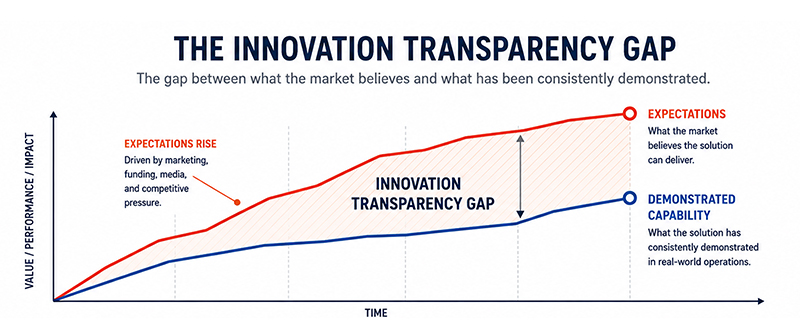
The Innovation Transparency Gap is the difference between what the market believes a solution can consistently deliver and what it has consistently demonstrated under real operating conditions.
At first, customer expectations and innovation capabilities overlap. Then marketing, funding, media attention, and competitive pressure push expectations upward. Capability continues improving but at a different pace. The result is a widening difference between expectations and demonstrated capability.
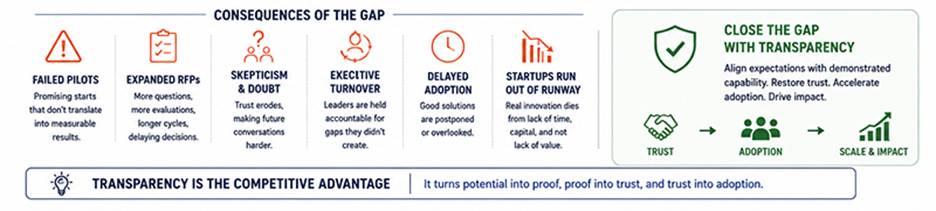
Inside the gap live failed pilots, endless RFPs, customer skepticism, executive turnover, delayed adoption, and startups that run out of runway despite solving real problems.
Every unnecessary pilot, every RFP expanded to dozens of questions, every executive asked to defend missed expectations, every startup that runs out of runway despite solving a real problem, is not an isolated event. Together, they are symptoms of the Innovation Transparency Gap.
Cost of inflated expectations
Inflated capability claims, unrealistic timelines, and inconsistent execution collectively bred distrust that severely hindered innovation adoption in an industry historically known as a slow mover. From risk-averse established solutions to overzealous startups, speculation and hesitation among decision-makers were seeded.
This affects all innovations striving to gain a foothold. Legitimate innovations with potential struggle to gain traction in the industry. This results in an elongated sales process that eventually leaves most of these solutions out of runway. They end up getting shelved, pivoted, or sold off at a fire-sale price that only benefits bargain hunters.
The accountability gap
Over the past decade, I watched executive turnover often treated as a leadership problem. Frequently it is an organizational transparency problem.
In almost every case, the public narrative focused on market conditions, competition, funding, or execution. But looking more closely, a recurring pattern emerged: internal understanding of capability maturity had drifted away from external expectations.
When engineering, product, sales, executive leadership, investors, and customers each operate from different assumptions about solution maturity, someone eventually becomes accountable for the resulting gap. Leadership turnover is often the visible consequence of that deeper organizational misalignment.
Transparency as a Competitive Advantage
Transparent companies build trust faster because customers understand both strengths and limitations. Early adopters become partners instead of critics. Product teams receive better feedback. Investors have more realistic expectations. The focus shifts less from proving claims to determining organizational fit.
The observations I have from the industry and the ideas discussed in this article ultimately led me to develop the ARS² Framework, a structured approach for helping organizations communicate innovation maturity with greater transparency. Establishing an industry tool for solution providers to fast-track adoption by demonstrating transparency and building trust more quickly.
The speed of trust defines the future
Innovation is a shared responsibility. Solution providers must become more transparent. Customers must reward transparency over polished demonstrations. This is how we disrupt the status quo. Solution providers need to be proactive and adopt a culture of transparency, and customers need to demand it and hold solution providers to their claims so both can collaborate effectively for a successful outcome. The customer needs to be aware of the current state of the innovation and be clear on when the right time is to engage. In contrast, solution providers can filter out those not suitable as early adopters.
Transparency is often viewed as a competitive disadvantage. In reality, it may be one of the strongest competitive advantages an innovation company can possess.
Customers rarely expect perfection. They do expect honesty about where a solution is today, what has been proven, what still needs work, and what it will take to get there. Trust is built not by claiming readiness, but by demonstrating it. Transparency is the foundation on which trust – and ultimately adoption – are built.
Innovation moves at the speed of trust, not at the pace of technology.

Georges Mirza is the founder of ComTask and a retail and CPG technology innovator who has helped shape the evolution of category management solutions and retail analytics. He has led the development of market-leading solutions widely adopted across the industry and pioneered advances in robotic data collection and image recognition to address critical retail challenges including out-of-stocks and inventory accuracy. Today, Georges advises retailers, CPG companies, and technology firms on innovation strategy, solution evaluation, connect with him on LinkedIn or email gmirza@comtask.com