Comprehension Gap: What New Wellness Products Get Wrong Before Anyone Reads the Label
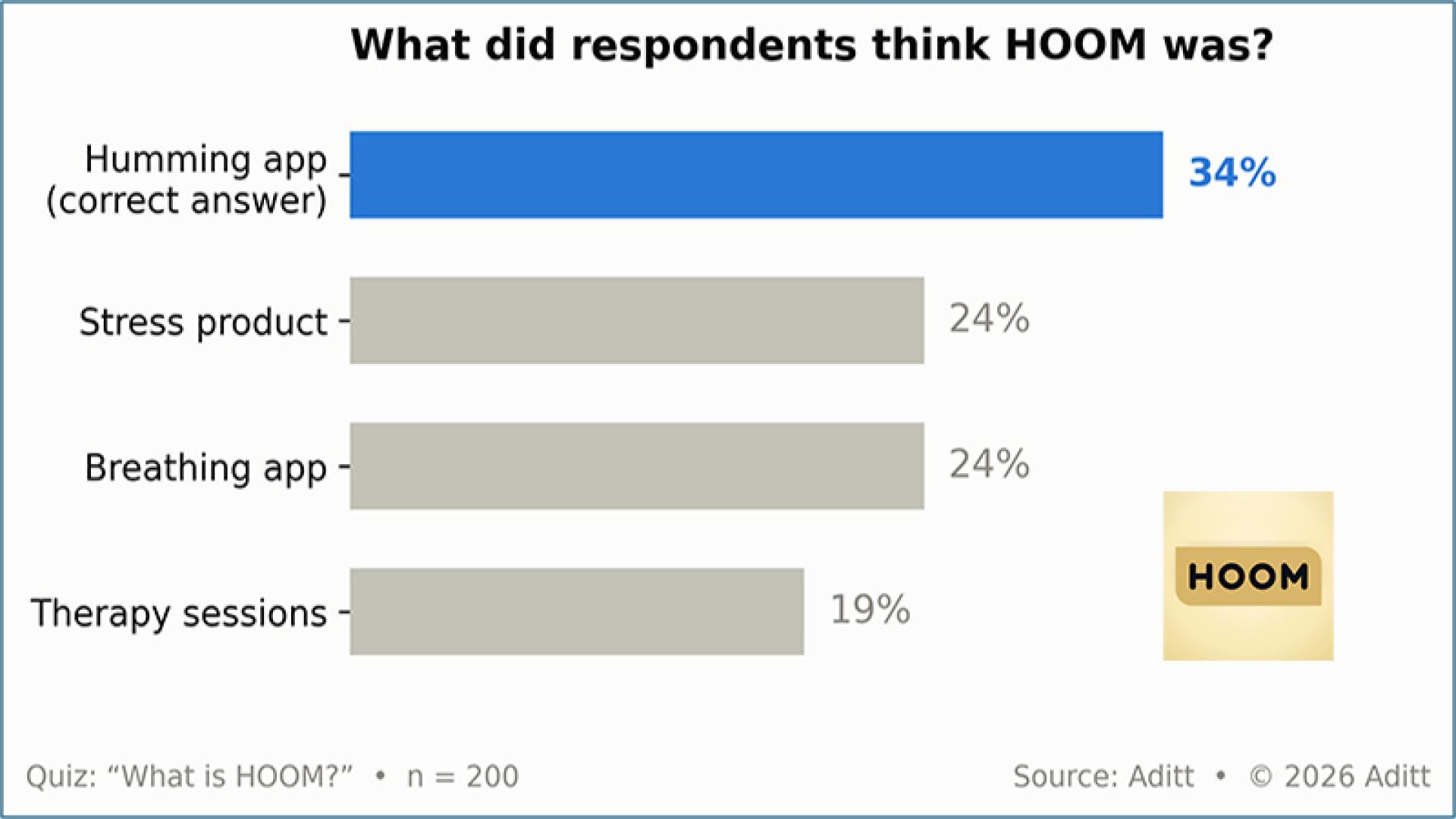
TWO OUT OF THREE people who watched HOOM’s launch video could not say what the product actually was. Once they understood the idea, nearly eight in ten called it credible.
That gap, between not getting it and not believing it, is the real story behind most new-concept launches in health and wellness today.
The category keeps producing products built on mechanisms most shoppers have never heard of: nervous-system regulation, vagal tone, novel delivery formats for familiar ingredients. The pitch can be sound and still fail if the audience never understands what they're looking at. A new comprehension study from Aditt, run against HOOM's real launch creative, puts numbers behind that failure mode, and behind the fix.
What is HOOM?
HOOM is a mobile app that guides users through brief, guided humming sessions built to activate the vagus nerve and shift the nervous system toward calm, with sessions running from 60 seconds to a few minutes. Founder Josh Jacobs built the app after noticing the calming effect humming had on his infant son, and the company has since backed its claims with peer-reviewed research. More at hoominc.com.
HOW THIS WAS TESTED
200 verified U.S. adults, sourced nationally as a cold, general-population audience, not existing users or category insiders. Each watched a 15-second video built from the brand's own launch stills, then immediately answered one comprehension quiz question and two opinion questions, capturing in-the-moment reactions rather than recalled impressions.
(Consumer research by Aditt · 200 verified U.S. respondents · September 2026)
Finding 1: The creative didn't say what the product was
Shown the brand's own launch stills, only 34% of respondents correctly identified the product as a guided humming app. The rest split across breathing app, therapy session, and generic stress product, reasonable guesses that all missed the actual idea. Comprehension was weakest among respondents 45 and older, at 23%, the lowest of any age group tested.
Finding 2: This is an introduction problem, not a rejection
Before seeing the campaign, 62% of respondents had never heard the core premise behind the product at all. Only 12% already practiced anything like it. The brand isn't competing against an established habit or a skeptical audience; it's introducing an unfamiliar idea inside a 15-second window, which is a much narrower problem to solve than “people don't believe us.”
62% of respondents were meeting the underlying idea for the first time through this campaign.
Finding 3: Familiarity earns belief. Correctly naming the product barely does
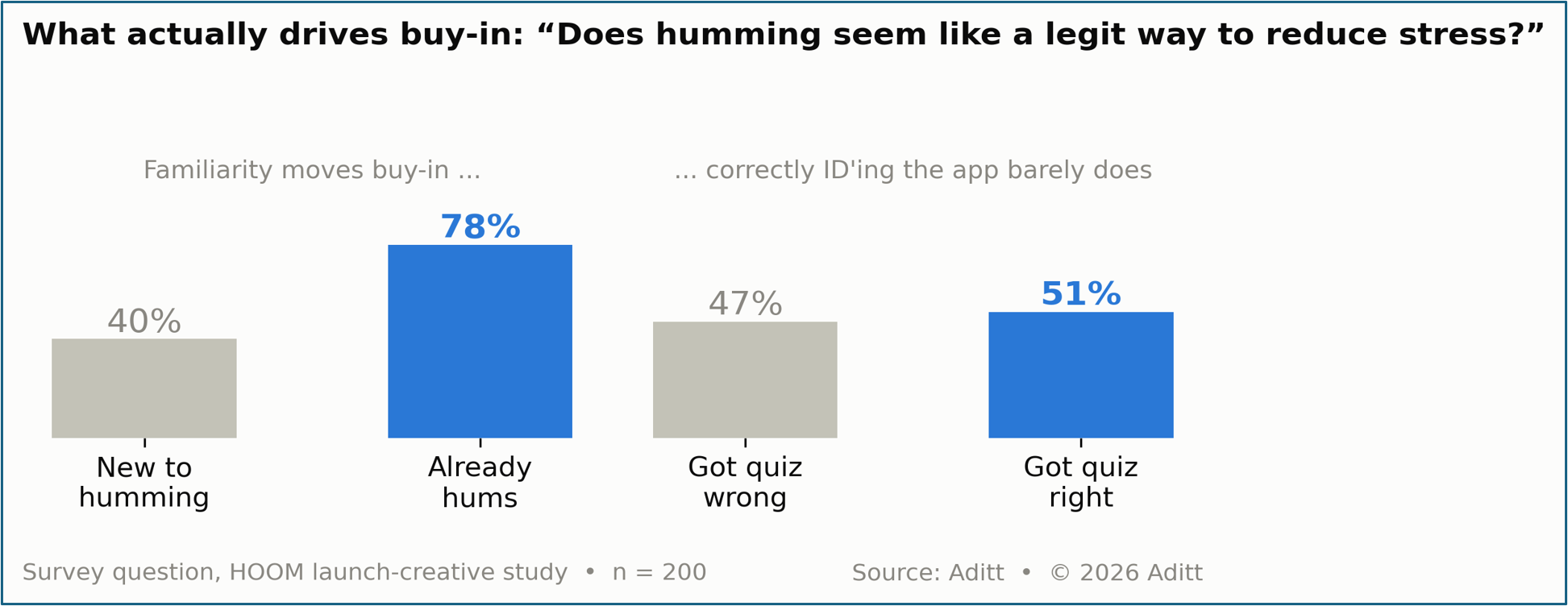
Respondents were queried: “Does this seem like a legitimate way to address the problem it claims to solve?”
Those already familiar with the underlying concept found it credible 78% of the time, versus 40% among those meeting it cold, a 38-point swing. Getting the quiz question right barely moved the number: 51% among respondents who correctly identified the product, versus 47% among those who didn't. Understanding what the product is and believing in the idea behind it are two different battles, and the data says the second one is far easier to win than the first.
What this means for CPG marketers
Any brand asking shoppers to accept an unfamiliar mechanism, not just a new flavor or format, is fighting a comprehension battle before it's fighting a persuasion battle. Pre-launch testing that only measures sentiment (“do you like this?”) can miss a campaign that nobody understood in the first place. A comprehension check, run in-context and immediately after exposure, catches the actual failure point: the moment where a viewer either gets it or doesn't, before they ever get the chance to decide if they believe it.
A Comprehension Check vs. a Standard Survey | ||
| In-Context Comprehension Test | Standard Opinion Survey | |
| What it measures | Comprehension: what a viewer understood in the moment | Opinion: what a respondent says they think, often after the fact |
| When it's captured | Immediately after exposure to the actual creative | Typically recalled later, outside the original context |
| What you learn | Whether the concept itself is landing, separate from whether people like it | Whether people like an idea they may not have fully understood |
| Source: Aditt 2026 | ||
 Drew Ruchim is CMO and Co-Founder of Aditt. https://aditt.app/ Brands use Aditt consumer research to gain early signal on which videos resonate, what messaging lands, and which concepts are worth scaling — all before committing serious ad spend. Source data and methodology available on request. Connect on LinkedIn