E-DAM is Next for Space Management in the AI Era
WE HEAR ALOT about the potential of Artificial Intelligence to impact Category Management and Space Planning and we anticipate how emerging tools and processes will enable more precise merchandising decisions and faster speed to shelf.
What do brands need to understand about AI and prepare for in their retailer engagements? There are three dimensions to master:
- Technology. Adopt AI tools that search, recognize, count, parse, analyze, plan, promote, explain, compare, report, recommend, and present require accurate, complete, consistent, and up-to-date data and images.
- Practices. What was “good enough” for legacy applications like planogram software or print advertising is not sufficient for new technology like image recognition, virtual reality, and AI-enhanced search and analytics.
- Workflows. Retailers are asking brands to support their new data and image workflows for products, fixtures, in-store marketing, and even stores.
Gone are the days when a supplier sales rep could just fill out a new product form, drop off a sample, upload 2-D images to a portal, or let the retailer do the work and assume the cost.
Also gone are the days when retailers could cobble together their product libraries from multiple sources of data and images.
The new item set-up: E-DAM ahead
Going forward, most (if not all) retailers will re-engineer their Item Set-Up process to an Enterprise Digital Asset Management (E-DAM) system that supports all internal departments and systems with product data and images.
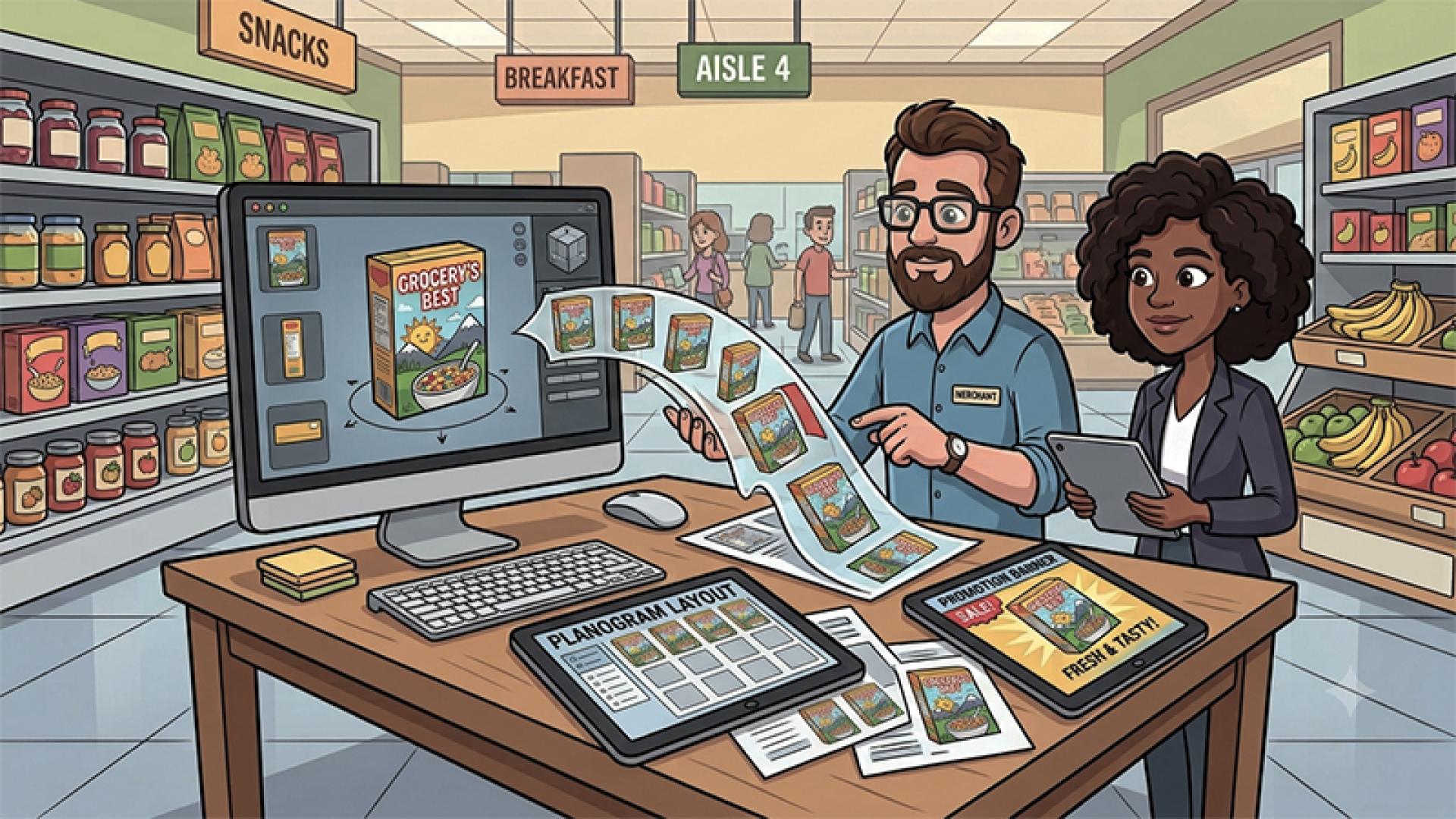
Every active and proposed SKU will enter the E-DAM as a high-resolution 3D model. The system will then use AI-enhanced optical character recognition and image recognition to populate descriptions and attribute fields.
It will auto-generate scaled image views for a wide range of use cases, including advertising, asset protection, business administration, e-commerce, point-of-sale, retail media, shelf tags, space planning, store operations, supply chain, virtual and augmented reality, and 3rd party services like in-store implementation, planogram and display compliance, and inventory counts.
Because each retailer has its own assortment, systems, security requirements, taxonomy, and use cases, every product and packaging update must be captured into each retailer’s specific E-DAM using the same process and quality standards.
Supporting each retailer’s unique E-DAM will require brands to invest in new product content fulfillment people, processes, and budgets. These resources will ensure the right products, packages, signs, and even fixtures reach the right retailers and content capture services. They will maintain a documented record of what was sent, when, to whom, why, and with confirmation of receipt.
Vendor success re-defined
On the retailer side, legacy cost centers built around separate, siloed item set-up for multiple use cases can be transformed into what I’d call a “Vendor Success Program”. This program would enable trusted vendor partners to use retailer-specific data and images for shared planogram projects, shopper testing, analytics, and other initiatives — helping to improve collaboration, share the workload, and maintain accuracy and consistency in joint business planning.
A paid subscription to a Vendor Success Program could include for example:
- Item set-up
- Product data and images as needed for specific use cases
- Retailer POS and shopper insights data
- Planograms
- Floor plans
- Virtual store environments
- CatMan scoreboards and templates
- Licensed system access (e.g., retailer configured versions of space software)
- Retailer-led training seminars
- Collaborative Space Projects
- Retailer Systems and Data
- Retailer Scorecards and Analytics
Over the next decade, AI will reshape many retailer functions and processes, changing brand relationships and expectations. Supporting AI and other emerging technology requirements will become table stakes for brands as they do business with retailers.
Ultimately, these investments will deliver faster speed to shelf (and screen), more precise sales and supply chain decisions, and stronger markets for products.
 David C. King is a former merchandising executive with Walgreens and Rite Aid, with more than 40 years of experience across the retailer, manufacturer, and solution provider sides of the CPG business. He is a CMA Certified Professional Strategic Advisor, author of Selling with Space Management, and former guest instructor in space and category management at DePaul University. Contact him at: david.king@catman.global